-->
no
no
Showing posts with label nature. Show all posts

Art of Noticing in Club Med Tomamu

No comments
Art of Noticing in Club Med Tomamu
Art of Noticing


One of the key things to slowing down is to stop, look and observe. It means taking away (or even hiding) your phone and camera, and taking the time to notice things around you.  I was introduced to Rob Walker's book "The Art of Noticing" by my friend, Shiyun just a few months ago, and it was very timely too as I was preparing for my nature workshops that I was invited to conduct by VSS at the Green Beats festival at Club Med Tomamu. With such busy lives we lead, I thought it very apt to have workshops that not only explored my creative process, but also allowed the participants to relax and start noticing in their lives too!

A Piece of String
Walker's book has a variety of noticing exercises that help the creative process, the simplest being just taking a different route to work, or looking up instead of down. I always carry a sketchbook and pen when I'm out and about, but when in a creative moment, my favourite tool is not the pen and paper, but string!  A piece of string helps you focus your attention on an interesting spot, and if you don't know what to sketch? Just throw it up in the air and see where it lands. Surprise yourself.

Art of Noticing


Nature's Art Brushes at Club Med Tomamu
I encouraged my participants to explore nature through sketching, and then translating them into a collage on a cushion cover. We were very fortunate to find a scenic walk (just a few minutes away from the amazing resort) which ended in a forest! It was a very immersive workshops - everyone, including the 7 year old, was busy sketching before we headed back to Club Med for tea and painting.

Nature's Art Brushes

Nature's Art Brushes


I love how everyone's works come out different but beautiful all the same!

Hapazome Workshop, Club Med Tomamu
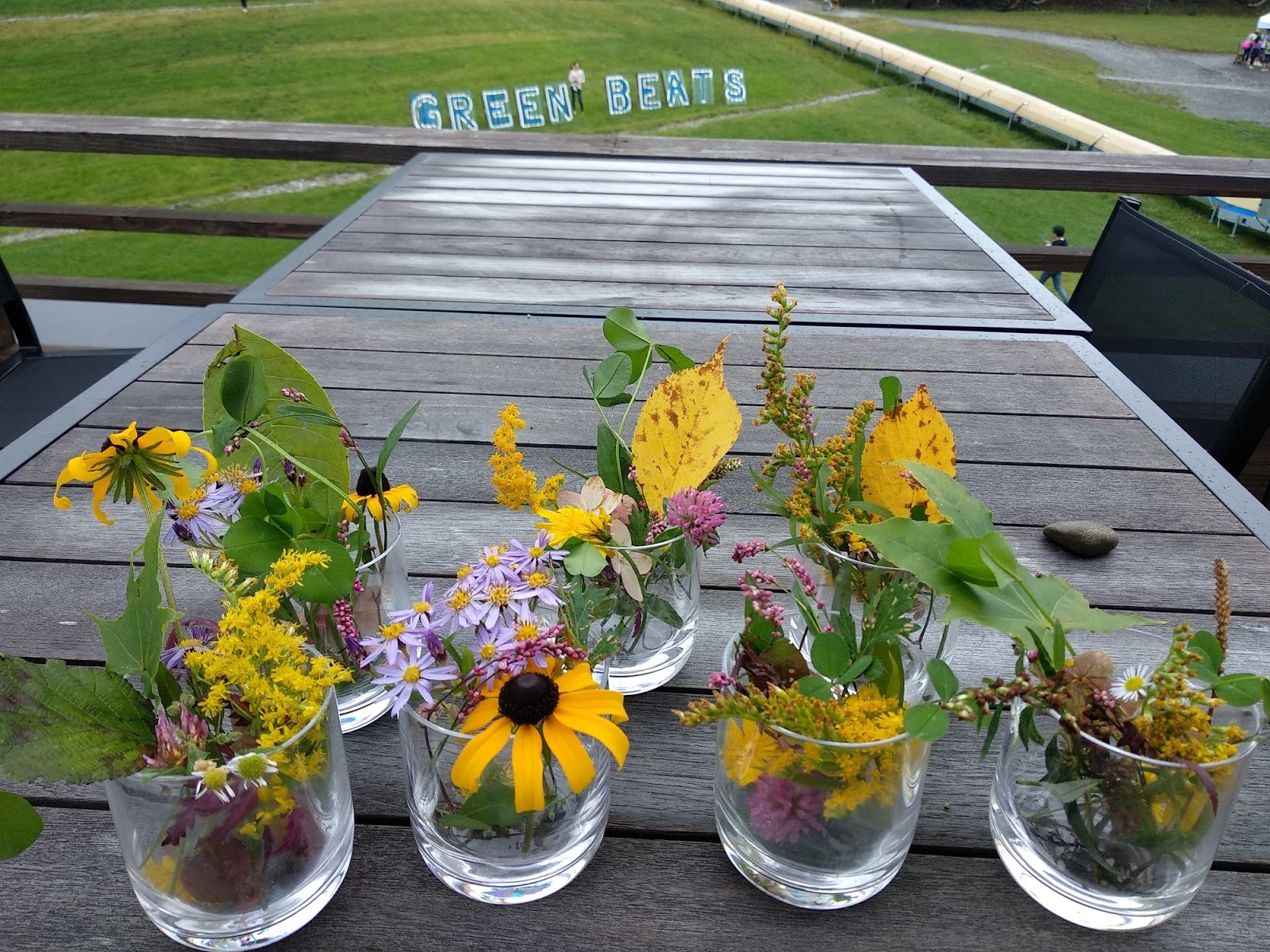
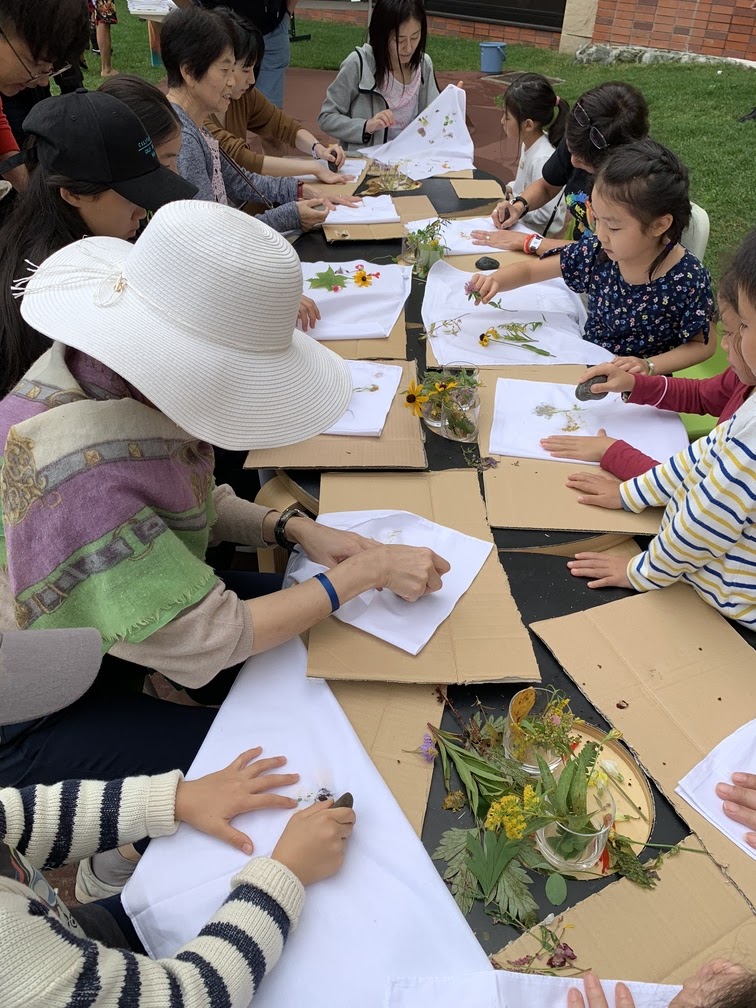
The other workshop that was held at Green Beats was hapazome. It was geared more towards children but we also had adults who were keen on taking part. Wild local flora were taken from the nearby walking trails (including the golden rod,  aconitum sachalinense ssp. yezonense,  mysotis sylvatica and achillea millefolium)


It was a great opportunity to share with the participants about the importance of nature! And, it was a wonderful moment for them to let off some steam with the pebbles - pound away!

Hapazome

Hapazome

Thank you to Jacqui Hocking of VSS for the wonderful opportunity to explore Hokkaido, and inviting me to take part in Green Beats by Club Med Tomamu.  Special thanks to Bamboo Straw Girl, Melissa, for helping me out at the workshops and taking all the great photos. Big thanks to Hermes Huang for finding out the names of all the flowers we came across during our first few days at the resort. Thank you also to Kenta of Club Med for being the translator.
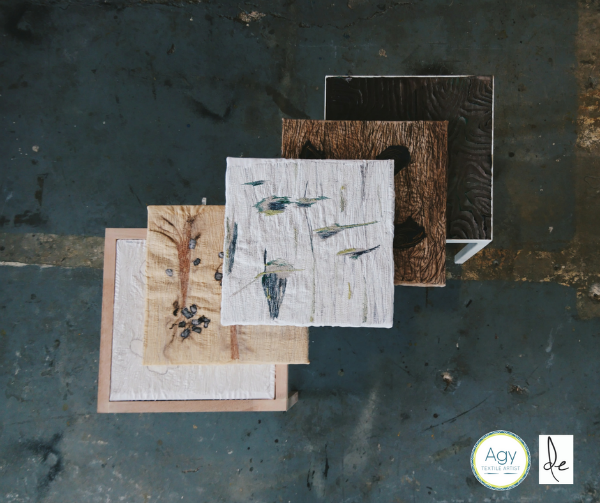
Upcycling & Nature Installation - Nature in Stitches

No comments
Upcycling & Nature Installation - Nature in Stitches
Upcycling installation

And I've finished!

What started off as an idea in the middle of last year has come to fruition.
Nature in Stitches was originally going to be a catalog of stitched bark from the trees found in Singapore but then it grew into an upcycled piece comprising textile waste, reclaimed wood and metal. It's now being displayed at the Art Science Museum from 1 - 3 September as part of the Singapore Eco Film Festival

None of this would have been possible without the support of Jacqui Hocking, Adeline Seah and Tulika Kapoor, the amazing team behind the film festival. And of course, the lovely guys, Robin and Poh Hong responsible for making the upcycled and embroidered tables, Designed.


What is Nature in Stitches?

Nature in Stitches interactive installation comprises a stitched interpretation of bark encased in reclaimed wooden and metal coffee tables.   It is used to portray the connection between slowing down and appreciating nature and what it has to offer to us. 

The Trees

I featured 5 trees that I see regularly on my walks in Singapore and have extremely interesting textures. They are the candle nut tree, the broad-leafed mahogany, golden shower, and the yellow flame. 

Trees of Singapore

The Process

I used free motion embroidery, hand stitching, applique and natural dyeing techniques. I think the most difficult part was getting the natural dyes right, and finding the right materials for the tree bark.

Materials: textile waste, reclaimed wood, metal
Techniques: upcycling, free motion embroidery, hand stitching, applique
Natural dyes: mango leaves


Agy Textile Artist

Agy Textile Artist

Reconnecting with Nature - Eco Dye

2 comments
Reconnecting with Nature - Eco Dye
Happy new year everyone! I cannot believe how fast 2016 went. For me, 2017 will be all about embracing slow, taking a step back and reflecting.

Reconnecting with nature


Reflecting is Very Important But...

Don't dwell on the past! Dwelling is when you judge yourself too harshly and the introspection goes haywire like a record on repeat. Stop! Reflecting is all about looking at what was good, what was bad and then LETTING GO. Making the improvements that you need and MOVING ON.  Would a walk in the park help?


"A Concrete Jungle Destroys the Human Spirit"

My friend, H, started illustrating nature. I saw her sketches of the birds she spots during her nature walks and thought how relaxing it would be. On my way to work last year, I decided to take more notice of what nature has to offer. We may be a city, but the trees that we have along the roads offer some respite from the concrete jungle. In fact, nature has a positive impact on our well-being, not to mention provide loads of inspiration to creatives (think the Bronte sisters).

"A concrete jungle destroys the human spirit" Lee Kuan Yew

When I am taking notes and making sketches in nature I notice how this process that evolves has a calming effect on me. But it has also made me realise that no matter how well intended our actions of reduce, reuse and recycle (the 3R mantra!) are, we sometimes forget that the main intent is not to create jobs, not to get the economy to grow year on year, but to protect what little fauna and flora is left. The rest is just secondary.
My recent visit to Pulau Merambong just off the coast of Singapore couldn't have left me feeling anymore so. It is full of marine life but unfortunately its existence is being threatened by recent reclamation works. In fact our tour guide mentioned that the rich diversity of species there would mostly likely disappear by 2018 - we saw seagrass, seaweed, anemone, mangroves and crabs.
On a more personal note, I have been asking myself should my work also reflect the beauty of our surroundings so that others would at least start to appreciate them?

free motion embroidery
My interpretation of Sea Anemone


Eco Dye

My thoughts turned to eco dye expert, Terriae Kwong, who I had interviewed several years back.  I contacted her and met up with her during my trip to Hong Kong. During my meeting with her, she was kind enough to share with me her process. I definitely learnt a lot from Terriae and here are some key pointers:

Eco dye with Terriae

#1 Know Your Plants 

I take this whole process of eco dye as an opportunity to know your flora. Terriae knew her eucalyptus leaves from her Chinese tallow.  Each type of leaf and flower imparts a different colour to the fabric it touches.

#2 Be Patient

This is something that can't be stressed any further. Slow clothing is all about, well, SLOW! The process of eco dye can take up to 4 hours or even more.  It's your opportunity to appreciate what you are doing too.

#3 Appreciate Natural Fibers

Terriae explained that it was important to use natural fibers in eco dyeing. While blends are good, she went on to say that dyes from leaves are brighter on non-synthetic textiles. If you are looking at changing the colour of synthetics, sublimation is the best.

Eco dyes can be toxic - wear gloves!

#4 Safety is Important

Although we associate eco and natural as being non-toxic, this is not true. Natural things can be toxic, the eco dye process can be toxic especially with the use of mordants. Wear gloves, work in a well-ventilated area - I don't think I can stress this any further. Terriae highlighted the need to do this and to ensure that her beautiful cat, Mogi, didn't eat her materials.

Terriae and Agy after the eco dye process

#5 Appreciate the Unexpected

It's like opening a present. As what I said before, there will be surprises and you don't know what the effect will be. Don't be disappointed if it's not what you are looking for but perhaps, like life, you can turn something disappointing into a positive!


Do you remember this post? Remember to check it out!
how to be an explorer of the world
no
no