I've finally decided to take the plunge. After requests from friends and my readers, I will be having my first free motion embroidery workshop in Singapore! It will be happening on 18 August at The Fashion Makerspace.
It's all about breaking the rules!
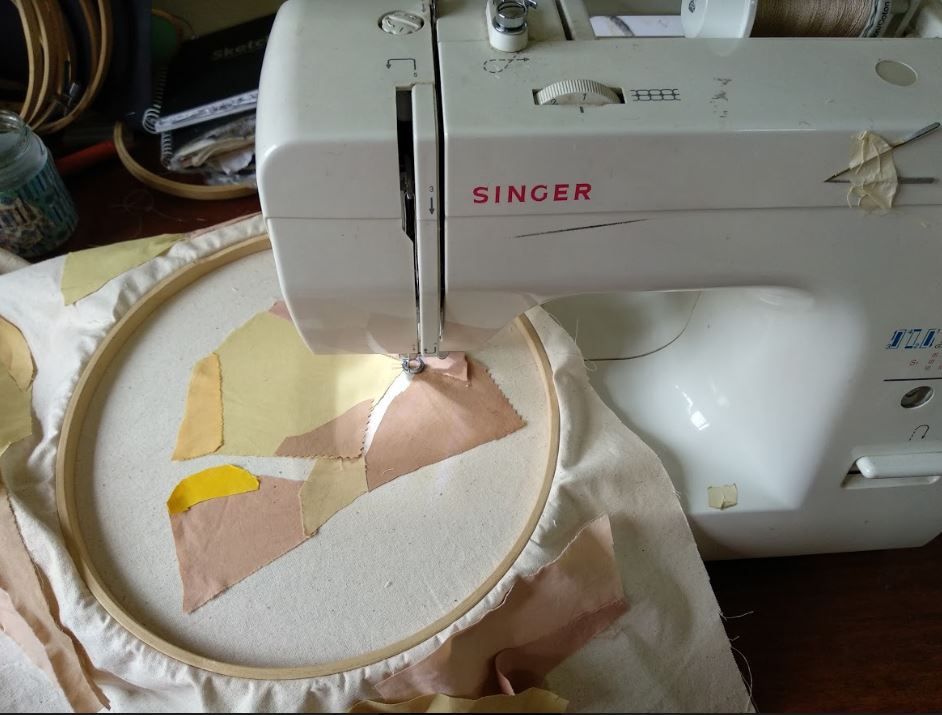
Want to break the rules when using a sewing machine? Are you longing to sew something other than a straight line? Then Free Motion Embroidery (FME) is for you! Join this informative yet practical class run by Agy Textile Artist. At the end of the session, everyone gets to take home your own free motion embroidered tea towel! This is a workshop where you can unleash your creativity – no need to stay within the lines! Templates will be given for the design, but feel free to bring your own.
Participants must know how to operate a sewing machine and be confident in machine sewing. For ages 12 and above.
This is an introduction to free motion embroidery technique.
What You’ll Learn:
How to set up a basic sewing machine for FME
Basic FME techniques
How to create a basic FME applique design
What You’ll Learn:
Feel free to bring any cotton scraps
Classes start on time, please arrive 5 mins early if possible. This class will only start if there are a minimum of 4 participants.
ABOUT AGY:
Agatha Lee (Agy) is a textile artist interested in the interactions between people and the natural environment, and how this relationship can be improved. Her work is mostly process-based, and she works with textiles, primarily by creating textile collages incorporating her observations through stitching (hand and free motion embroidery) and marking. Her current work looks at making the unseen visible to the community, enabling them to appreciate nature. Her work has been exhibited at The Festival of Quilts (UK) and The Knitting and Stitching Show (UK).
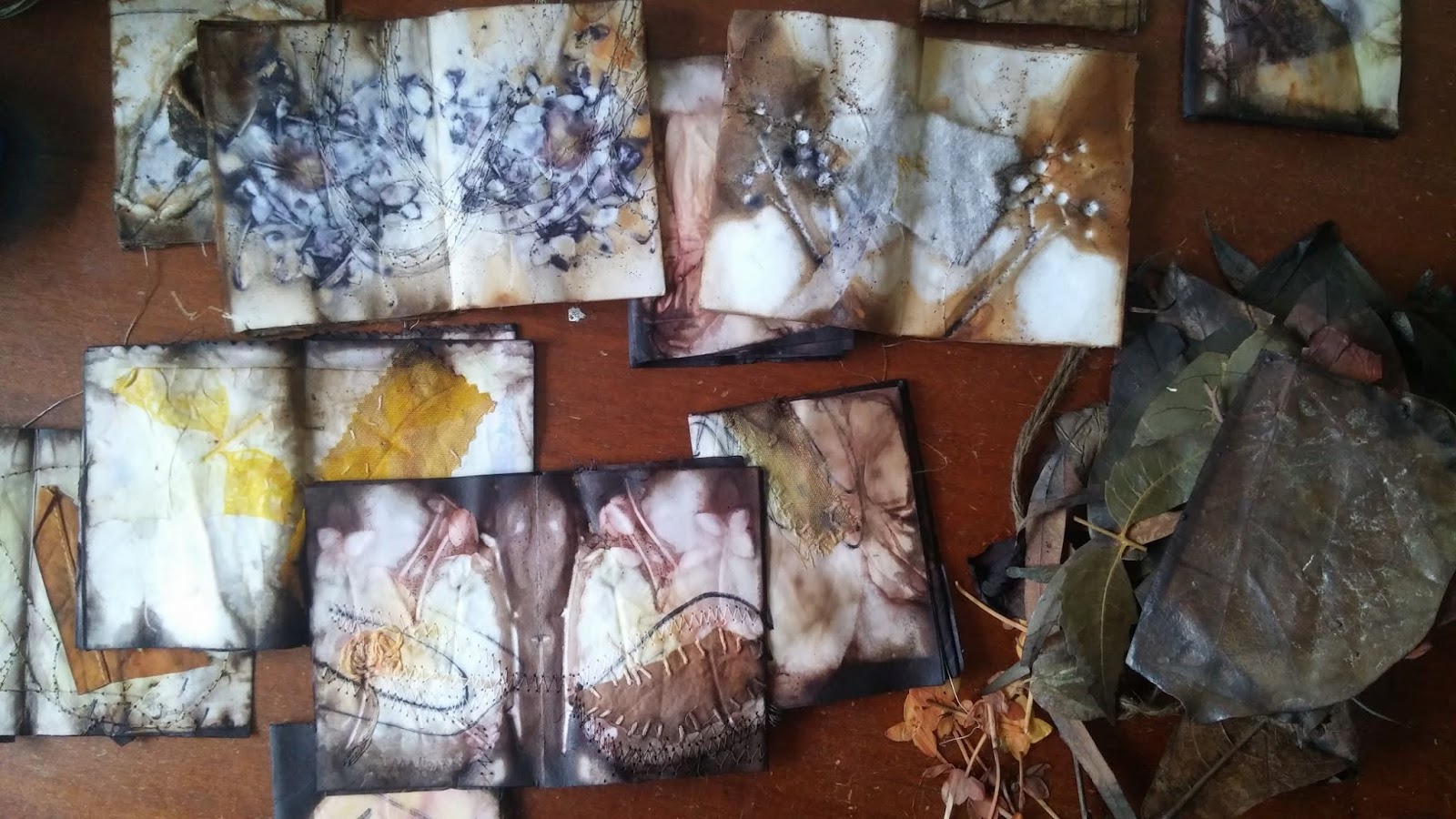
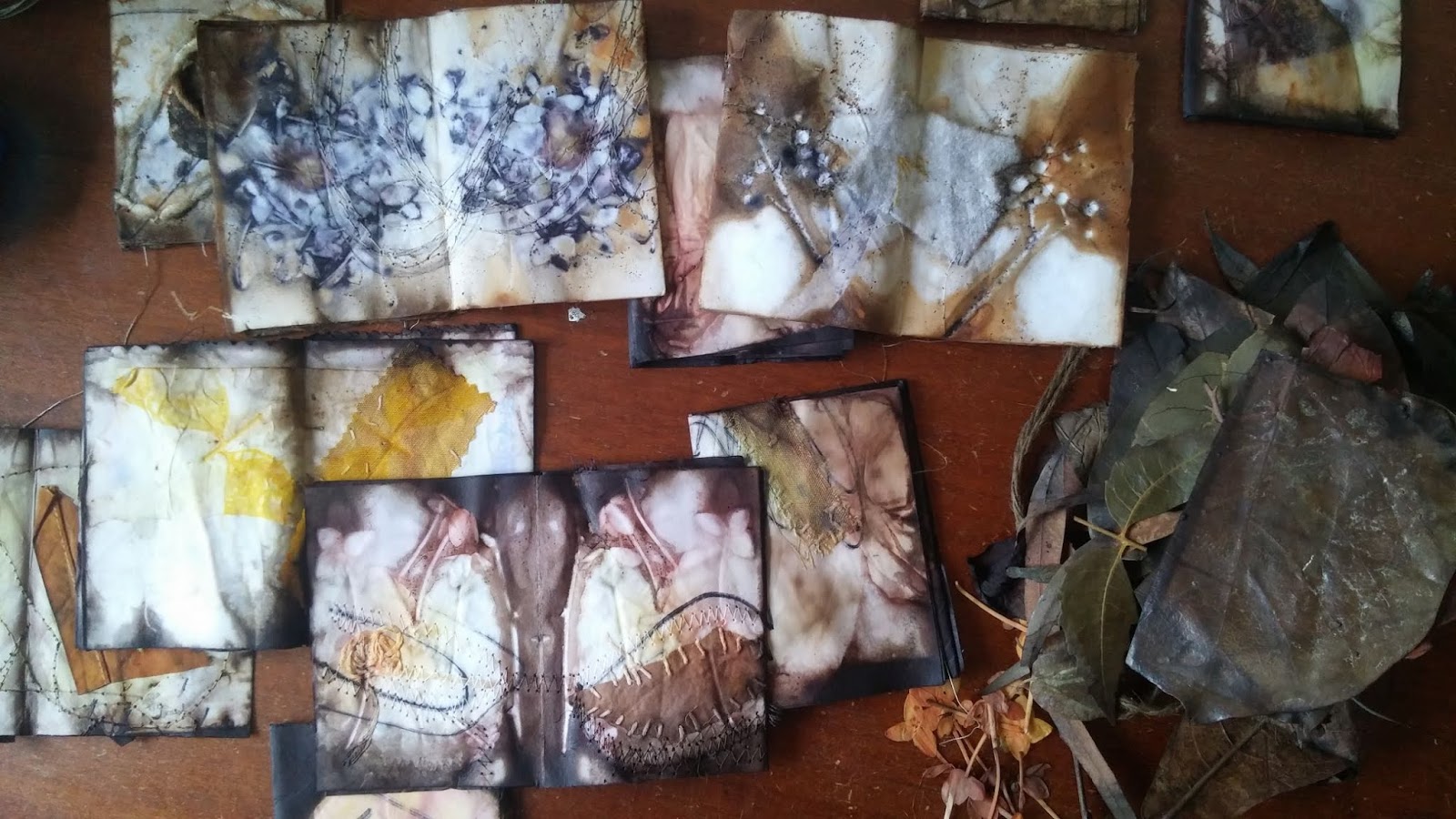
Stitch Meditation does not have to be restricted to fabric. You can try other media as well. In fact, I decided to upcycle my stash of paper and fabric scraps. There's always a way to reuse them in the most interesting way, and stitch meditation and upcycling them into little booklets was perfect. Inspired by India Flint, I scribbled, I stitched and I folded. And then I eco-printed. As some of you may know, I had posted on my instagram what my freezer looked like - basically a garden waiting to be cleared out.
I used bits of paper scraps, natural fiber fabric scraps (naturally dyed, some just plain) and then I raided my freezer and slipped them in between the folds of the stitched booklets before tying them up into bundles. I used a brick to make sure everything was held in place.
The 2 stacks were boiled in separate pots for about 30 minutes - the bricks were too big for me to put into one pot - before being cooled down and left for about 2 days.
I love how the colours in the 2 stacks came out different and this was very obvious with the way the ixora turned out as you'll see in the videos below. Please excuse the way the videos turned out - I realised I was speaking way too slowly and having you sit through 20 minutes of boring monologue would be painful.
Next steps will be to sew all these beautiful booklets together!
You may recall the coral bowls I was working on post-Green Is the New Black installation. The project slowed down and went on the back burner for a while because I couldn't find a place to have it installed. I eventually decided to not do bowls but instead have them encased in glass. Although the end point is not as intended you can still see the fragility of the corals.
Sometimes things don't turn out how you want them to, but I am sure these coral bowls will eventually find their way back into the light!
These coral pieces will be on display and for sale at The Actually Affordable Art Fair (Camp Kilo) on 7 April (2 - 7pm)
I spent the first quarter of this year looking at the invisible.
I looked down all the time, but not at my gadget but at the weeds on the ground.
Weeds are a grossly misrepresented plant. We have been taught to get rid of them because they "invade" our manicured gardens and landscaped areas. But did you know that weeds are restoring plants, they bring the trimmed lawns back to their natural state - they are restorative plants. Apparently, weeds lets us know how healthy the soil is - so if you encounter a lot of weeds, instead of reaching out for the weedkiller (actually you shouldn't), it's important to observe and "listen".
Weeds also bring in diversity while monocrops don't, including a variety of insects and pollinators.
I don't have a green thumb, but I do know that diversity is key to a better planet.
The items are for sale at the Actually Affordable Artist Market, 7 April, 2 - 7pm.
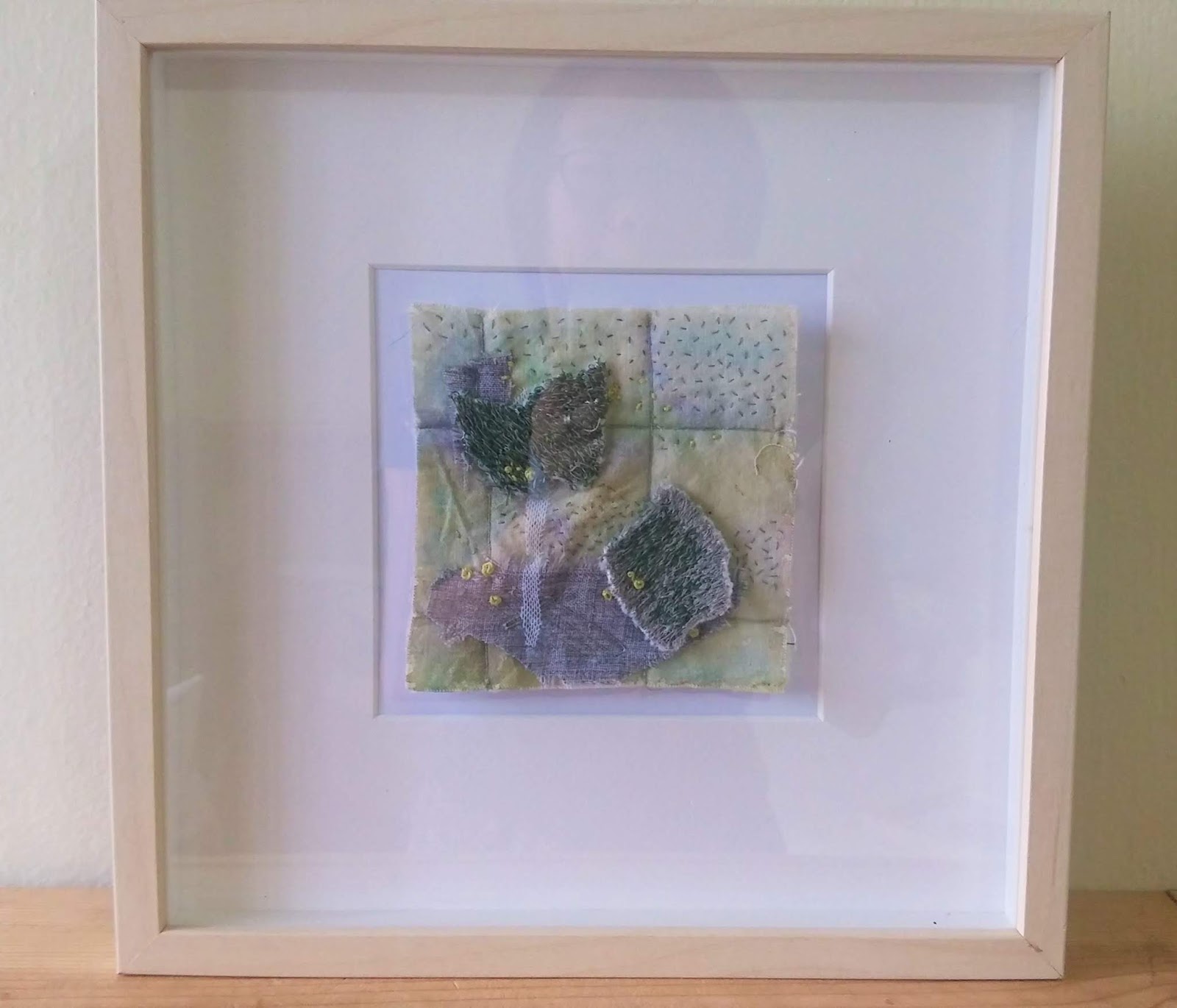
4x4" fabric collages, each free motion embroidered.
Being an artist means observing things that others don't notice.
The small shoots growing on the kerbside, the tufts of grass struggling for sunlight between the tiles, and the flowers scattered all across the pavement from a tree in full bloom. I begin to see how our natural and humans are "living together" maybe not in perfect harmony, but perhaps trying?
Finding My Inner Tortoise
I recently wrote about how slowing down allows me to draw my attention to these tiny details. Taking a walk through the park or even just deliberately looking at things that I wouldn't normally look at has drawn me to sketching and translating them into stitch. I think I can now say that I am no longer tree blind! (pssst - put down that phone!)
The Wet Season
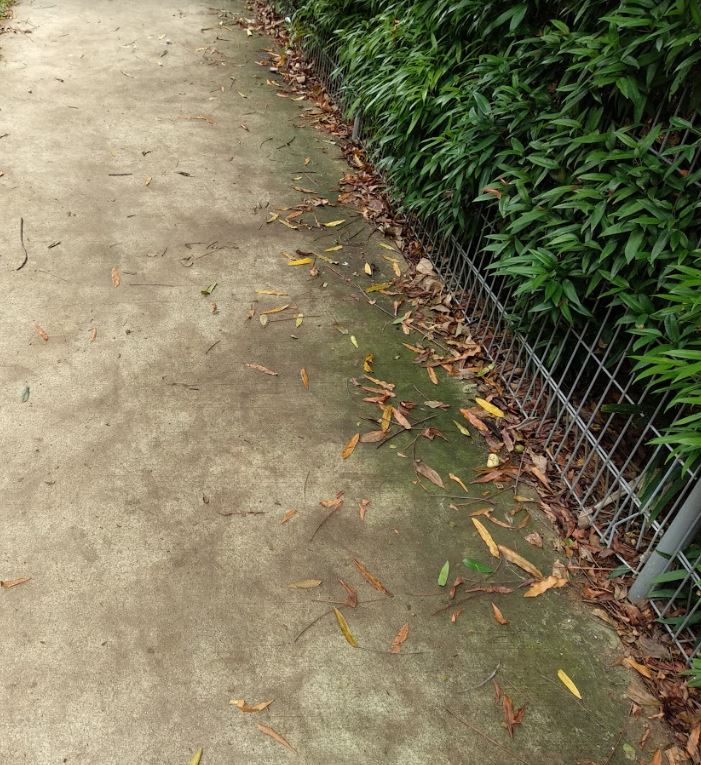
It's been really wet in the last part of the year in Singapore. If you walk past a eucalyptus tree, you'll notice how the leaves make marks on the pavement after a heavy downpour. It's nature way of communicating with us. After another period of rain, the tannin marks get washed away and new marks get made in their place - different patterns reflecting different moods of the weather!
I wanted to translate and communicate this interaction of nature's marking on our lives through an eco-printed and embroidered piece. I had experimented with ecoprinting but wanted to produce a more subtle and grey look on the piece. This involved using more diluted iron solution to give a gentler washed out look. Once the eco-printing was complete, the piece was then layered with hand and freemotion embroidery - this alludes to the complexity behind nature's interaction with us.
The final piece is 100 x 50cm. Fear had held me back for a while before I could complete this, but once I let go and just (as my friend told me) "do it because there's nothing to lose", everything fell into place. Even if it doesn't become something I like, I can always put it away for later or use it for something else. There's always a way!
🌱Leaves in the Rain🌱 100x40cm Eucalyptus leaves ecoprinted on fabric offcuts. Handstitch and free motion embroidery
Did you get a chance to visit Pameran Poskad last week? I just managed to visit on the last day and am very grateful for those of you who adopted three of my works. If you are keen to give my work a new home, do drop me a message! The items that remain are listed here.
One of my postcards is inspired by kintsugi. I have an obsession with kintsugi. You might remember my happy pants upcycled from my husband's shirt. It's happy because I patched it with colourful scraps and stitched it with kintsugi-inspired free motion embroidery. But I am taking inspiration from this postcard to make my own pair of shoes under the instruction of shoe maker, Lisa Teng of Lisa Teng Studios. Why shoes?
My Shoes Are Falling Apart
I bought a pair of shoes online. They looked really nice and they had received lovely reviews, not least because their goal was to feed hungry children around the world. After 3 months, they started to tear along the edges, and it was the first time I had experienced this. I consulted Lisa and she suggested that I remove the leather uppers from the sole and visit her workspace for a mending session.
I will keep you all updated on what's going to happen to the uppers but it's such a shame to throw them away. I'm looking forward to sharing with you what my "new" pair of shoes will look like after the session this Thursday.
Inspired by Kintsugi
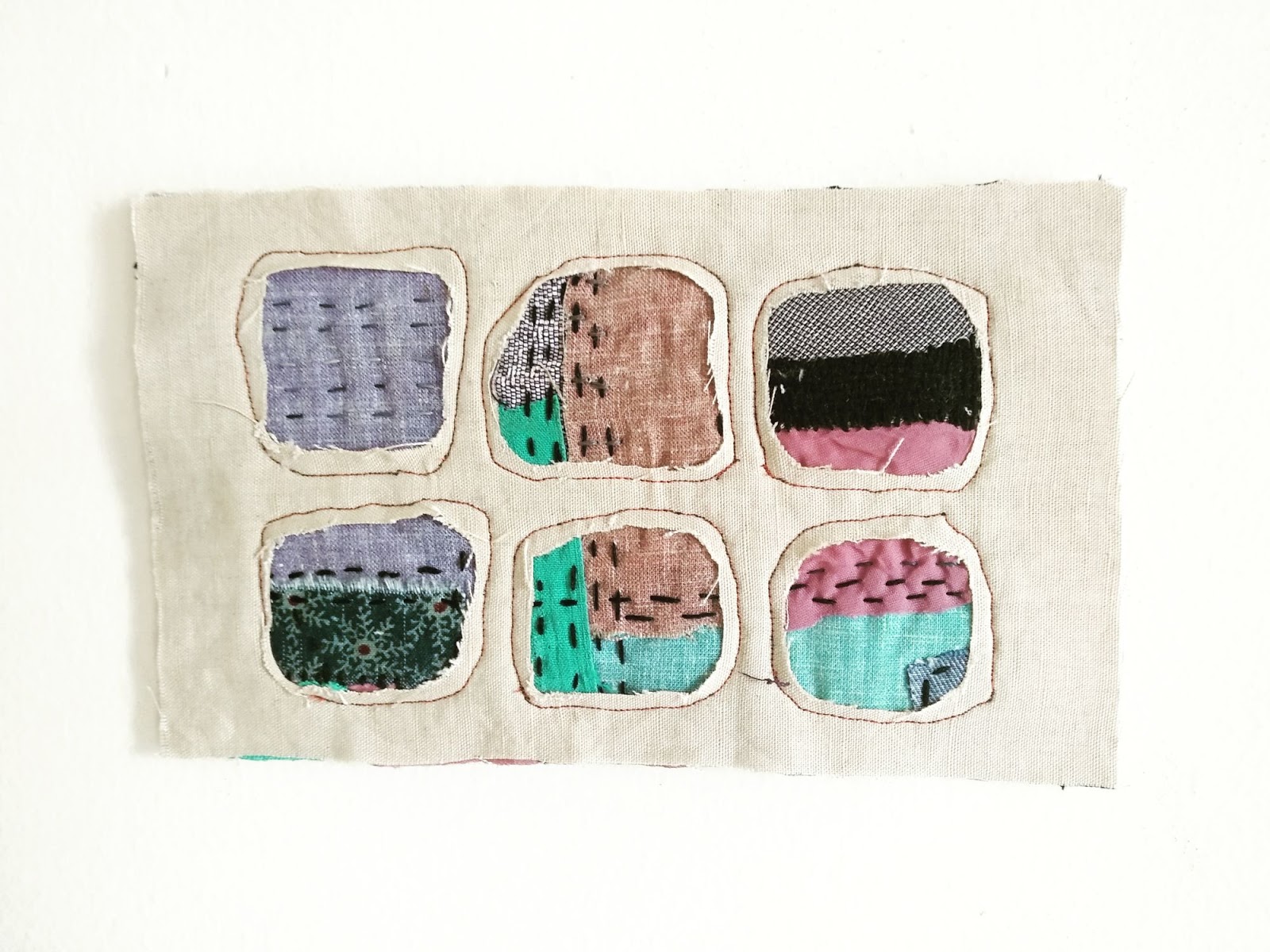
Needing to mend my shoes also got me wondering how shoes are made. Have you ever thought about it? Lisa said I should start with espadrilles. I wonder how long they will take to make. I decided to draw inspiration from my favourite theme, mending with kintsugi. I took my scraps of naturally dyed fabric from my experiments - hey, it's upcycling - and sewed them together on calico. What's next? Stay tuned for Part 2!
Here I am aligning all my little bits of naturally dyed fabric scraps onto the pattern.
It took me a while but I am so glad that I didn't rush through the sewing for the postcards. I am so pleased with the results. Please read the descriptions of each piece and I hope you can see where the inspiration came from. Find out more about the process of making them in this post.
These postcards will be on display at Pameran Poskad from 15 - 24 July at ION Art Gallery, ION Orchard, Singapore.
Postcard 1/10 Mending - Superficial 1 Price - SG$48 SOLD On the surface everything looks great, but peel back the layers and you will find the journey of pain and healing. Textile waste Naturally dyed with eucalyptus leaves
Postcard 2/10 Mending - Superficial 2
Price - SG$48 SOLD Sometimes mending just covers things up. Are we really finding a solution? Textile waste, free motion embroidery Naturally dyed with eucalyptus leaves.
Postcard 3/10 Mending - Painful Memories 1 Price - SG$78 The world is full of anguish and despair. We desperately try to fix it but it creates one problem after another. In doing so, we create painful memories. Textile waste, free motion embroidery, handstitching, Natural dyes with avocado, eucalyptus leaves
Postcard 4/10 Mending - Painful Memories 2 Price - SG$78 I took inspiration for this from the patches used to repair clothes or quilts. Sometimes the mending only covers the bad and isn't the solution, hence the warped stitching and patches in this piece. Textile waste, free motion embroidery, handstitching.
Postcard 5/10 Mending the Mind Price - SG$88 The mind is so complex that it is difficult to pin point a remedy to alleviate the emotional turmoil a person could be going through. It could run deeper than we think, and no quick fix will be able to pull the person through all the mind's layers and into the light. Textile waste, free motion embroidery, handstitching
Postcard 6/10 Mending Relationships Price - SG$58 SOLD The relationships between you and your friends changes over time. Sometimes it's good, but other times it just disintegrates. How do we reestablish these broken connections? May be it takes mending what's on the inside first before offering your friendship again. Textile waste, free motion embroidery, handstitching Natural dyes - eucalyptus leaves
Postcard 7/10 Mend Nature or Fix Ourselves
Price - SG$68
Nature has its own way of resetting itself, so we shouldn't be mending nature but rather changing the way we behave towards it. It could be consuming less or going vegan. Every action counts!
Textile waste, free motion and hand embroidery,
Natural dyes with eucalyptus bark and leaves
Botanical printing - rambutan leaf
Postcard 8/10 Mending - Blinded
Price - SG$58 Are we blinded by our own experiences? Sometimes what we believe to be the solution is just something that restricts us from seeing the bigger picture. This is a reversible postcard. Textile waste, Free motion embroidery Natural dye with mango leaves
Postcard 9/10 Mending - Beauty in the Broken 1 Price - SG$58 Part of my slowing down journey involves embracing imperfections - I try to remind myself, don't sweat the small stuff! Textile waste Naturally dyed - mango leaves and avocado Free motion embroidery
Postcard 10/10 Mending - Beauty in the Broken 2 Price - SG$58 Embracing imperfections in life. Textile waste Naturally dyed mango leaf, avocado and tumeric Free motion embroidery
Have you ever wondered how resilient nature can be? Lay cement to make a pathway, and few blades of grass will peek through after a few months. Under the hot sun, a white wall will become dull and as the season changes to bring rain, shades of green and grey moss will appear. I find it fascinating how nature responds to the built up environment, and discovered interesting features that could be incorporated into my heavy machine embroidery. Not only that, I also realised how much of this mirrors our life, navigating through different challenges, making crucial choices, and growing personally everyday.
So, I was very excited when I received an email from textile artist, Dionne Swift, to take part in her exhibition, Collective Stitches. She was gathering interest from all her students to showcase their work, and of course I said, "Yes!". Being based in Singapore, I don't think I would get such an opportunity, so I got cracking in November after my art residency at the L'Observartoire, and got the three heavy machine embroidered pieces sent to England.
2nd May - Hawar, Oldeberkoop, Netherlands www.hawar.nl
11th - 14th October Knitting and Stitching Show, Alexandra Palace, London
8th - 11th November Knitting and Stitching Show, Dublin, Ireland
22nd - 25th November Knitting and Stitching Show, Harrogate, Yorkshire
A Life's Journey
"The three pieces, Embracing the Storm,Challenging Choices Ahead, and Cultivating Resilience, were inspired by the walks that the artist took from her place of work to her home. Each time she took the journey, she noticed how nature’s way of dealing with adversity is a reflection of our own mechanisms in coping with the different stages of our lives. From the uncertainty during the heavy rains to the plant that is able to grow under distress, these pieces are a reminder that struggles do not last forever."
Embracing the Storm ~30 x 30 cm textile waste £190
Challenging Choices Ahead ~30 x 30cm textile waste £190
Cultivating Resilience ~30 x 30cm textile waste £190
Old raggedy threads (ORTs). I didn't know that the thread remnants from sewing and embroidery projects would have a special term; I had always called them scrap threads. After a little research, I realised that orts is actually a word that was used in the 1700s to mean remains or scraps of food, and it has Germanic origins!
I had never thought of upcycling my scrap threads. Previously I would throw them in the bin, basically treat them as waste. When we think of waste, we do not associate it with words such as "valuable", "significant" or "energy". One of my readers, Kassy (thank you, Kassy!), shared an article on my facebook page . This short yet important post shares the cultural significance of orts. The author, Ms. B, details how she made an orts box for a friend and then shares this beautiful paragraph:
"Orts are the tiny snippets of thread left over from sewing and embroidery. For many generations and in many cultures these bits of thread held great importance. On a base level, they represented a part of a resource (thread) that still had use as fire starter materials, stuffing, etc. But there was a higher significance as well. These were remnants of the spirit of the artists or crafts persons who used them. So, like hair or cast off clothes, orts gained a spiritual designation and were saved for special uses. They have been found in “Witch Jars” in Viking Era York and Colonial Era New England in both Pagan and Christian context. In Latin America, they are mixed in with the straw in the Christmas Manger Scene. Overall, they are considered to be lucky and full of positive energy."
I like how Ms. B says that orts are remnants of the spirit of the artist or crafts person who used them. As we sew a stitch in a project, we create a story, one that is unique to the maker. And as we complete the set of stitches and cut off the tails of thread, we may think that we are ending the story - we are not. By placing them into our own special orts container, we are saving them for our next narrative. So by saving them and upcycling them in our next project, we are continuing our journey as an artist / sewist both spiritually and physically. Let's all channel this energy through our work!
Do you have an orts container?
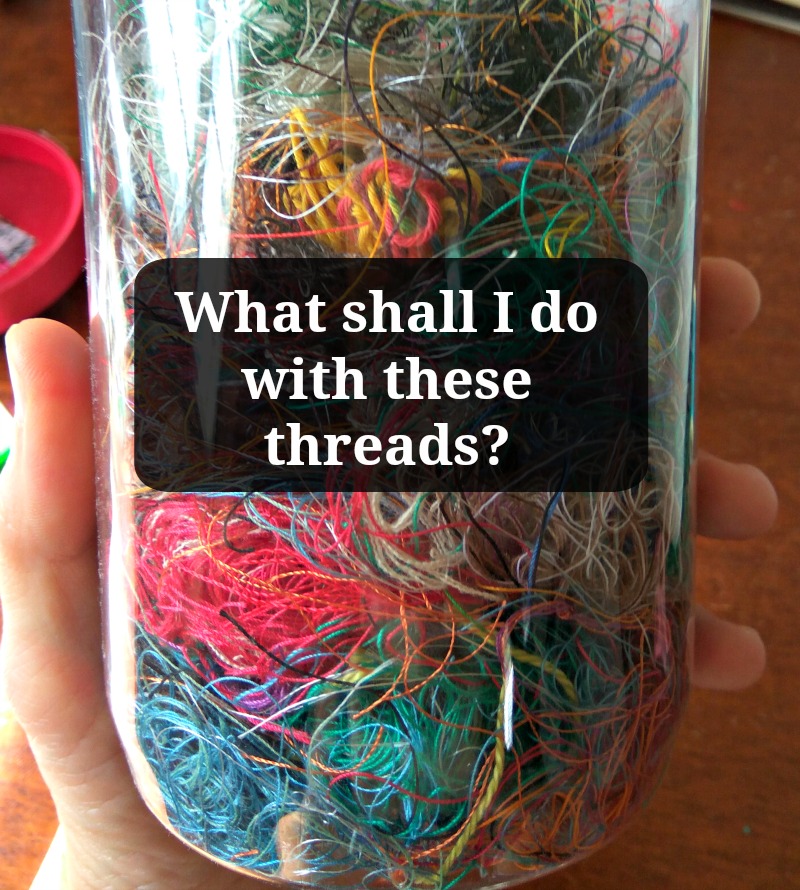
My orts containers are nothing fancy; they are upcycled from jars of nuts. They are clear so it makes it easier to select the scrap threads I want to use in my upcycling projects. I love the idea of having a smaller container to take with me if I happen to be sewing on the train (train rides have been horrendous in Singapore; on a bad day it takes me 2 hours to get into town, while on a good one, it is about 45 minutes to 1 hour. How do I plan my day if the duration is so erratic?). I will probably have a small zipper pouch with me.
How do you upcycle your scrap threads or orts?
I posed this interesting question to my readers a while back on facebook and I received a lot of feedback and interesting ideas!
#1 Sew between tulle or water-soluble material
This is something everyone should try and it is super fun. Just sandwich a lot of scrap thread between two sheets of tulle or water-soluble material and clamp in place with an embroidery hoop. Next, go crazy with your sewing machine - sew patterns, zig zag, straight lines or even do some free motion. The key is to make sure all the thread is fixed in one place. After running it under the tap or trimming off any excess tulle, you should have a lovely looking piece of work. Finally, I shaped it and made a bowl out of mine!
Janet turns hers into little patches that can also double up as coasters!
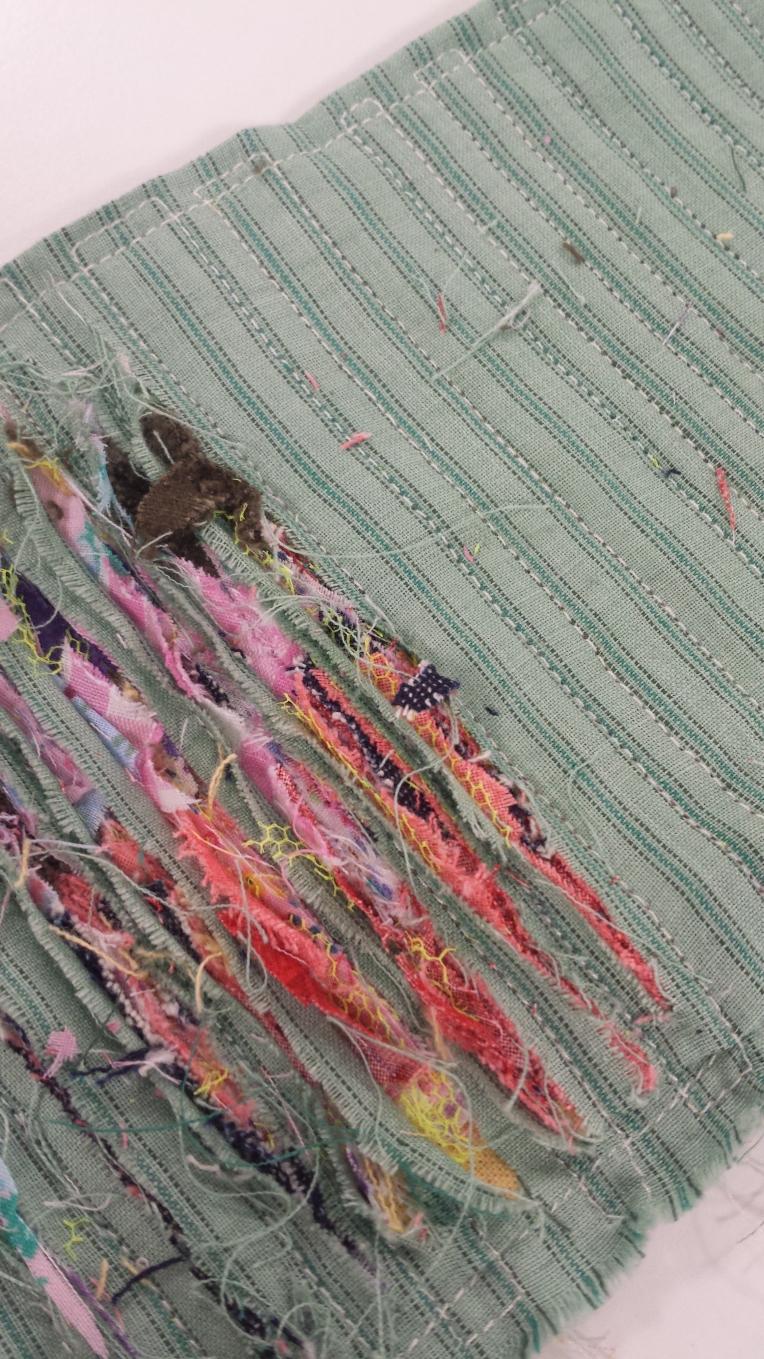
Why not sandwich them between cotton fabric and do some slashing, as recommended by this website. Image below courtesy of Hot Pink Haberdashery.
#2 Sew them into your projects, use them as embellishments
Yes, that's right! They can be used to represent anything you want. Use it to make a statement!
In "Anthropocene vs Symbiocene" one of my free motion embroidery projects, I had a whale struggling under a lot of plastic waste, which is represented by the threads.
#3 Put them outside near your birdfeeder or hang on the clothes line.
The birds will thank you with their beautiful singing! I didn't think that it would actually happen until a friend told me that she saw a bird fly off with a piece of candlewax in its beak. And, did you know that there is a bird that lives in Singapore (and other parts of Asia) and uses its beak to sew up a beautiful nest! Of course it is called the tailor bird. It picks up plant fibers (as well as your threads!) to sew up a nest.
Note: if you are intending to leave scrap thread, make sure they are natural fibers (no metallic or polyester).
Important update 3 Jan 2018: Since this post was published, a few readers have come to me with information that although we have good intentions, it is not advisable to put the thread out for the birds. This is because the dyes, mercerizations and processes can be toxic to birds, eggs and hatchlings. One reader has added that we have to "be aware that threads can wrap around the feet of a baby bird, cutting off circulation as they grown which then causes them to lose the use of the foot."
#4 Donate them to preschool for arts and crafts
Many of my readers suggested this, and you will be well-loved by the teachers. They are extremely busy preparing for class, so any donations that will allow them to squeeze some extra time for class prep would be really appreciated. Can you imagine cutting up thread and yarn for hours on end?
#5 Filling for toys and cushions
The scrap threads make perfect stuffing but it would take a bit of time to fill a cushion! I have a friend who has a cushion made up with a tiny whole for her to stuff the threads in.
#6 Use them for your mending projects
That would be boro style and it does look good on denim. Just grab a scrap piece of fabric, place it under or over the tear and start to sew running stitches (using your scrap threads) through the two pieces of fabric. For a tutorial on sashiko, visit this link or this one.
#7 Incorporate them into wet felting
I have never wet felted before but I have seen how you can incorporate different types of fabric, threads and yarn to give a different texture to the felt. Check out this pdf tutorial by Cloth, Paper, Scissors!
What do you do with your scrap threads? Do share with us.
Sometimes you need a change of scenery to make things work, to get those creative juices flowing, to just start on a new upcycling / sewing project! Well, I got that opportunity courtesy of my artist friend, Isabelle Desjeux. She very kindly allowed me to use her beautiful studio, L'ObservARToire, for the whole of October (in fact she has a line up of artists using her studio). I am really excited because it is nestled in a quiet part of Singapore, away from traffic, away from the crowd!
What I Will Be Doing - Reimagining
I will be reimagining nature, reimagining food waste, and more importantly, reimagining textile waste. Everyday, I will be foraging in my neighbourhood and around the studio for leaves, bark and even food scraps! It has started off well, and we have even managed to get the children from the Blue House International School to bring in some food scraps. So this month is all about upcycling, sewing and natural dyeing.
Why food waste?
We throw out so much food from ugly vegetables, expired produce and waste from the kitchen. Some people use their kitchen waste to make compost, but why not see what they can offer in terms of colour? By the way, food waste is a huge problem in Singapore. According to National Environment Agency, it accounts for 10 percent of the total waste generated while only 14% of it gets recycled.
Why nature?
Nature has a lot to offer to us - a relaxing environment, food, shade and services. But they also give us rich earthy colours.
Why textile waste?
We just have too much textile waste be it clothing, linens and furnishings. Just take a look at our thrift stores - we are just drowning in our own clothing. According to a recent documentary by Channel News Asia, The Salvation Army in Singapore receives 10 tonnes of donations of which 60% is clothing. And this amount increases to 60% during peak periods such as festive seasons! Throughout this residency, I will be using old hotel bed linen purchased from Hock Siong and old bed linens from Raffles Hotel (I must thank Muriel Boutin-Becuwe for helping me reach out to the hotel and getting their management to agree with passing them onto me for upcycling).
What's Happened During Week One
Week one was all about settling in, and can you believe that I forgot about my sewing machine during the move? I remembered my pots and pans, but the sewing machine got left at home. Anyway, it happens - I am getting old.
How do I feel?
To say I feel ecstatic might be an understatement. I am very happy to be in a work space without my family telling me to clear up my things after a project. Not to say I'm messy, but knowing that I have a wet and dry work space for my natural dye and sewing experiments is liberating.
I feel relaxed. The view is amazing so every time I need to take a rest, I just look at the view and take a deep breath - aaaaahhhh.
I feel inspired. We are so close to nature, so it's a great place to be foraging for my leaves, flowers and bark, but it's also an inspirational place too! We are also within the Blue House Nursery and International Preschool, and they have a great kampung (Malay for community) spirit, they have even agreed to contribute to the kitchen waste for the dyeing.
Eucalyptus Bark and Blue Pea Flower (Clitoria ternatea)
I dyed the sheets using the eucalyptus bark from my neighbourhood park, and I started to collect the blue pea flower from the hedges surrounding the school grounds. You might remember the last time I tried eucalyptus, and this time around I still get the rich earthy tones of the bark. I'm so glad I was able to replicate the results but important learning points this time around are:
Not to be greedy and stuff too much fabric into the pot; this results in uneven pigments on the fabric. Ideally, I should have a huge vat that is as tall as me, but alas.....
Keep stirring and watch the temperature... and time!
It might be possible that bark (or even leaves) collected during different times of the year produce shade of brown? I will have to try this out.
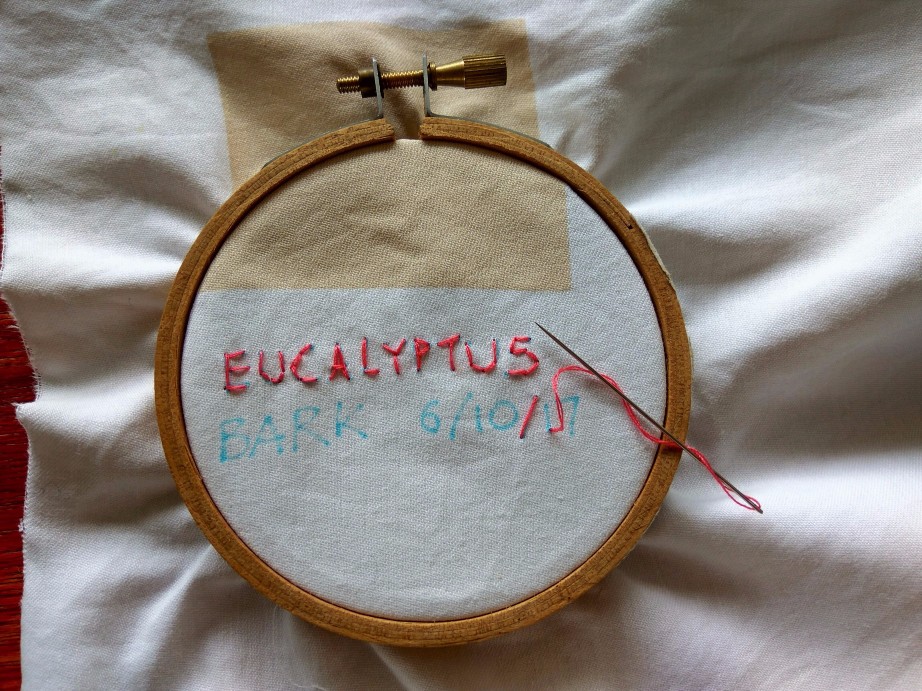
Always remember to label your samples and cloth prepared for natural dyeing. Preparing the cloth takes at least one and a half days so I take notes and label. I am still trying to figure out a good way to do the labeling.
Here are the results of the eucalyptus with immersive dyeing and screen printing.
Next is mango leaves and rukum masam!
Stay tuned for week 2.
Oh, I think I should start some stitching.
I find it wonderful how people can reconnect after so many years. On a recent trip to Hong Kong, I was linked up with a secondary school classmate who also happens to be an artist. I think both of us were wondering whether there would be any connection because we hardly spoke to each other in school, except for the occasional hello. Well, life does have its twists and turns, and we realised we shared a passion for the arts, education and the environment. What was supposed to be an art jam, ended up being a 4 hour discussion, and we forgot to eat!
Our chat ended off with a desire to collaborate, and soon I was texting Aranaabout upcycling bedsheets, rust dyes and free motion embroidery. Arana was off scouring her home by the beach for rust and using the seawater to create rust dyes with her old bed linens, while I was being inspired byChasing Ocean.
Rust Dye
I was very surprised by what you can find on a beach! Arana found this huge rusty chain that she then cut up and wrapped in her old bed linen. The colours that came out of the sea water soak were beautiful, and Arana added that it was fortunate (or rather, unfortunate) that at the same time, clumps of palm oil from a ship collision were washing onto the shoreline.
Dying Corals
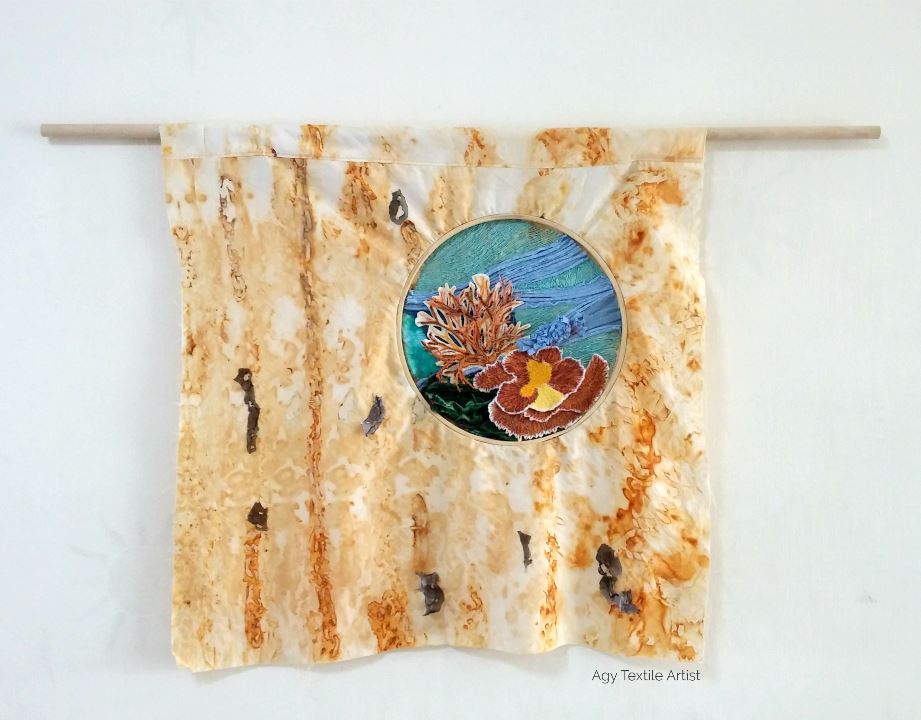
With this upcycled art installation, I wanted to depict the environmental pressures the corals are facing as their habitat is being eroded by warming sea temperatures, increasing water acidity and pollution. I don't think many people realise that the health of our planet depends on these underwater 'rain forests': Coral reefs support a quarter of all marine species (in terms of food and shelter) and half a billion people worldwide.
Although I was inspired by Chasing Coral, I focused on coral species that are found in Singapore's shores, the fan and plate corals. Free motion embroidery was used and I confined the coral to within the embroidery hoop, thus illustrating the shrinking healthy habitat they are living in.
Why Upcycled
We felt it was important to minimise the use of virgin materials as much as possible in this project. Human activity and consumption is the culprit of the demise of the coral reefs, and a lot of it is reflected in buying things, including clothing. In fact, research at Coral Reef Studies, Arc Centre of Excellence, Australia, has shown that corals are ingesting the microplastics (plastics less than 5mm long) that we produce. And where does microplastics come from? Health and beauty products, synthetic clothing, among others.
The base of the installation is old bed linens while the free motion embroidery was done with scrap materials from other projects.
Ocean is an upcycled art installation and will be on display at Green is the New Black, The Conscious Festival (1 October, 11am - 6pm, Park Royale Hotel on Pickering). Working for the first time, artists Agy and Arana combined their ideas and passion towards art and the environment. This collaboration illustrates how the environment affects every single one of us, no matter where we are in the world.